
Nine Miles Offshore
On distance, discernment, and the myth of safe places

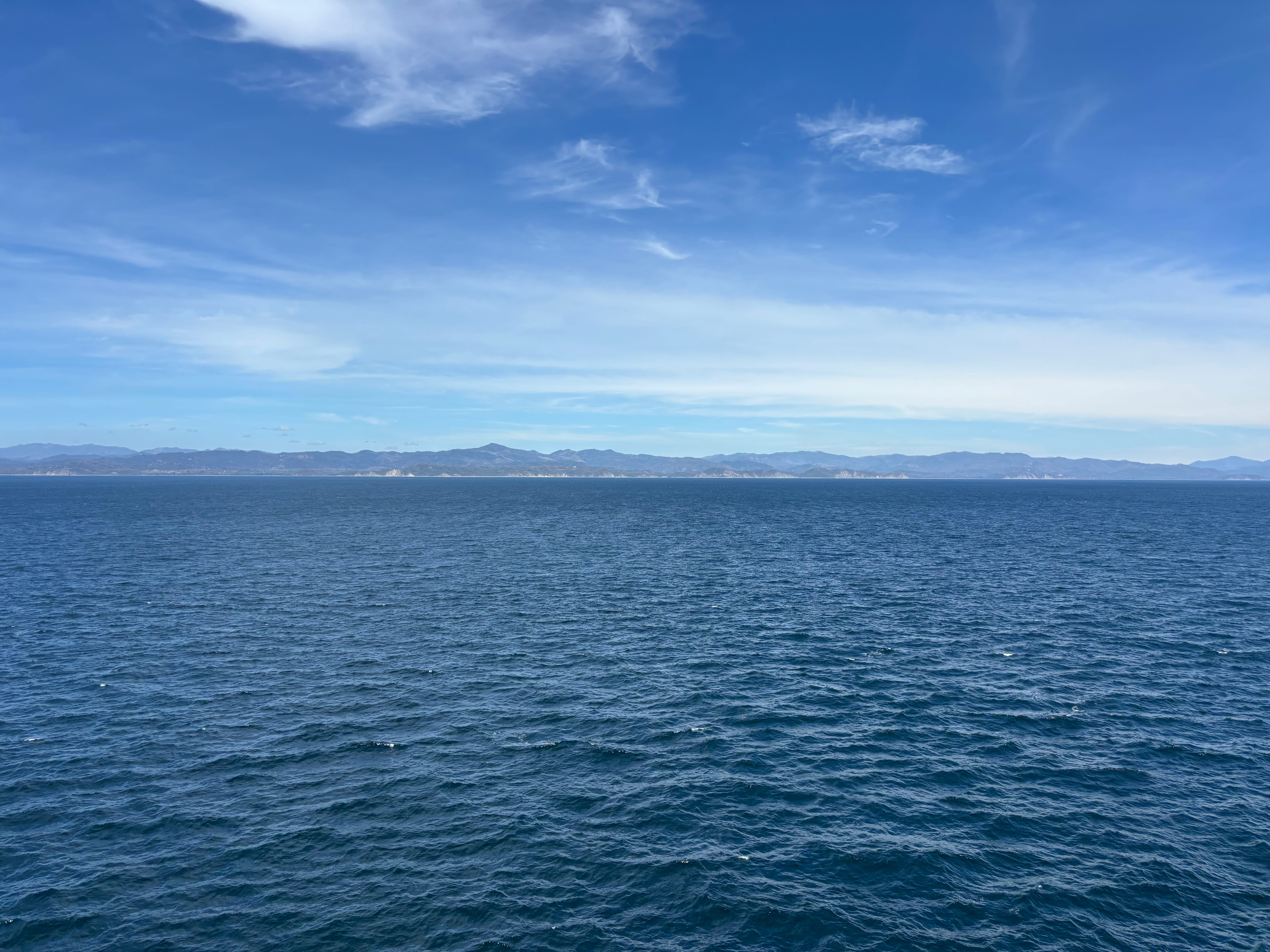
My five-part Divine Counterpart series concluded this week. As I exhaled that arc of writing, I found myself staring at the coastline of Costa Rica from nine miles offshore, holding a very different set of questions. What surfaced here didn’t feel like Part Six. It felt like something else entirely — something that belongs to this distance, this moment.
I am sitting on a cruise ship nine miles off the coast of Costa Rica.
From this distance, the land looks almost the same as it always has—green, dense, promising. It’s the same stretch of coast where I poured my heart and body into a dream for two years: an eco-resort that once felt like a lifeline. A future. A place of refuge. That dream is still alive and, in its own way, still moving forward. But the physical distance mirrors something internal. A quiet widening. A loosening of attachment.
When the project first came to me, it felt divinely inspired. Not imagined, not strategized—delivered. Over a dozen trips across two years, Costa Rica felt electric with adventure and possibility. Even the danger felt alive. Venomous snakes, treacherous terrain, the constant requirement of presence. Risk was tangible, but it was honest.
More than that, Costa Rica felt like protection. A buffer against the more existential threat I felt growing in my home country—the slow erosion of systems, the tightening grip of forces that value power over life. Costa Rica felt like an answer.
It still might be.
And yet, Costa Rica is not immune. No place is. The global march toward authoritarianism does not stop at borders, jungles, or ideals. Even sanctuaries exist within the same world.
This realization has been unfolding for me aboard this ship, a floating city of excess. My time here has felt deeply dystopian. I pick up my phone and witness what feels like a collective awakening—people coming face to face with the cavernous realities of the evil that has permeated nearly every structure we rely on. Some of us have been aware of this for a long time. Others are just beginning to see. Their shock, grief, anger, and confusion are palpable. And they require witnessing. Integration. Space.
All of this is happening while I am surrounded by abundance that borders on grotesque.
The plates of food. So much food. Endless. Disposable. The idle chit chat about nothing at all—what show to see, what dessert was better, what to drink next. I find myself wavering between allowing my nervous system to enjoy the decadence and feeling physically nauseated by it. Pleasure flips to aversion in an instant.
Then comes the guilt. For not feeling grateful enough. For judging. For being unable to simply “enjoy the moment.”
I am trying to let these feelings coexist without forcing resolution. To resist the urge to declare one response more moral or evolved than another. Perhaps this is what clarity actually looks like—not certainty, but honesty.
Maybe there are no truly safe places. No geographic solution that absolves us from reckoning with the world as it is. And maybe that was never the point.
Love and connection are not location-dependent. They can be felt and emitted anywhere—jungles, cities, ships at sea. Even here. Even now. Some days, that space inside me is harder to access. Not because it’s gone, but because it asks me to stay awake when part of me longs to escape.
I am learning that staying awake may be the work.
At the edge of this knowing, I call in Sedna, from Inuit cosmology. Mother of the deep, keeper of what sinks, the one who lives beneath the surface of what we would rather not see.
Sedna does not rescue.
She remembers.
She holds the consequences of human choices in her body—the broken agreements, the greed, the moments we turned away. And still, she feeds the world.
May she teach me how to stay with what is uncomfortable without hardening.
How to witness excess without becoming numb.
How to grieve the loss of imagined sanctuaries without abandoning my devotion to what is still possible.
Sedna reminds me that the ocean does not require innocence—only honesty.
That nourishment comes when we tend what has been neglected, when we comb the tangles, when we take responsibility for what we have touched.
I do not ask her to calm the waters.
I ask her to help me remain in right relationship with the truth of this moment.
To love without illusion.
To choose connection without escape.
To stay awake—even when the tide pulls deep.
That contrast is stark. You illustrate it so beautifully. I feel the push and pull of this piece.
Love the Sedna information...a really rough tale that has lessons for us all.