
Reverence Is the Magnet
On Love, Attention, and What Responds to Presence

January note: For this month, I’m offering a $111 Threshold Transition Doula session—a space for support when something in your life is ending, emerging, or quietly rearranging itself. These sessions aren’t about fixing or rushing clarity. They’re about staying present, embodied, and resourced while the next shape of your life takes form.
I’ve been thinking a lot about reverence lately.
Not reverence as ceremony or devotion.
Not reverence as something lofty or removed from real life.
But reverence as a way of standing inside the moment you’re already in.
This week’s podcast conversation with Cynthia Abulafia helped crystallize something I’ve been circling for a long time: reverence, love, and manifestation are not separate practices. They’re the same movement, expressed through the body.
Not in the “vision board” sense.
Not in the “positive thinking” sense.
But in the way we relate to what is already here.
Love isn’t a feeling—it’s a field
We often talk about love as an emotion—something that happens to us. But lived love feels more like a field we inhabit. A posture toward reality. A way of meeting what arrives.
When I look back at the most meaningful things that have entered my life—relationships, opportunities, places, creative work—they didn’t arrive because I wanted them harder or visualized them more clearly.
They arrived when I softened.
When I stopped bracing against the present moment.
When I stopped demanding proof before trust.
When I allowed myself to be changed by what I was already touching.
That softening is reverence.
And reverence is magnetic.
Why forcing manifestation rarely works
So much manifestation language is built on effort:
Raise your vibration.
Eliminate doubt.
Get clear, get certain, get specific.
But when I sit with my own life—and with the lives of people I support—I see something else entirely.
The most aligned things arrive when we stop trying to extract outcomes from life and begin relating to it instead.
Reverence doesn’t demand results.
It listens.
And listening changes what can find us.
Transition is where magnetism is forged
This is especially clear in my work as a Transition Doula.
People come to me when something has ended or is ending—a relationship, a role, a version of self—but the next chapter hasn’t announced itself yet. They often feel unmagnetic in these moments. Unclear. Untethered. Afraid that because they don’t know what they want, nothing good can come.
But transition is not a void.
It’s a tuning ground.
When someone learns to stay with uncertainty without abandoning themselves—when they honor grief without collapsing into it, and desire without rushing it—something subtle but powerful shifts.
Reverence during transition looks like:
not forcing clarity
not betraying the body to meet a timeline
not pretending everything is fine
not demanding the future reveal itself early
That kind of reverence creates coherence.
And coherence attracts like things.
We are magnets—but not the way we’re taught
I do believe we are magnetic beings. But not because we “think correctly.”
We’re magnetic because everything in us is vibrating—heart, nervous system, breath, attention. When those vibrations are fragmented by urgency or fear, what we attract often reflects that fragmentation.
When they begin to harmonize—when we treat our own experience with reverence—life responds.
Not always immediately.
Not always dramatically.
But with precision.
Love doesn’t pull things toward us.
It aligns us with what already belongs.
What reverence looks like in my life right now
Right now, reverence looks surprisingly ordinary.
It looks like:
moving slowly with decisions instead of demanding certainty
honoring my body’s limits even when my mind wants more
staying with unanswered questions without turning them into problems
choosing what feels alive over what looks impressive
I’ve noticed that when I live this way, things don’t rush in—but they arrive intact. Not distorted by grasping. Not inflated by fantasy.
Just real.
And real things last.
Manifestation as relationship, not reward
I’m starting to believe manifestation isn’t a reward for good behavior or correct thinking.
It’s the natural outcome of relationship.
When we relate to life with reverence—with curiosity, care, and presence—life responds in kind. Not as a transaction, but as recognition.
Love recognizes love.
Coherence recognizes coherence.
And what we call manifestation is often just the moment those recognitions meet.
If you’re in a season of wanting—wanting clarity, partnership, purpose, direction—I don’t think the invitation is to want less.
I think it’s to want with reverence.
To stay embodied enough to be shaped by what’s unfolding, not just impatient for what comes next.
That’s the work I do.
That’s the way I’m learning to live.
A closing invocation
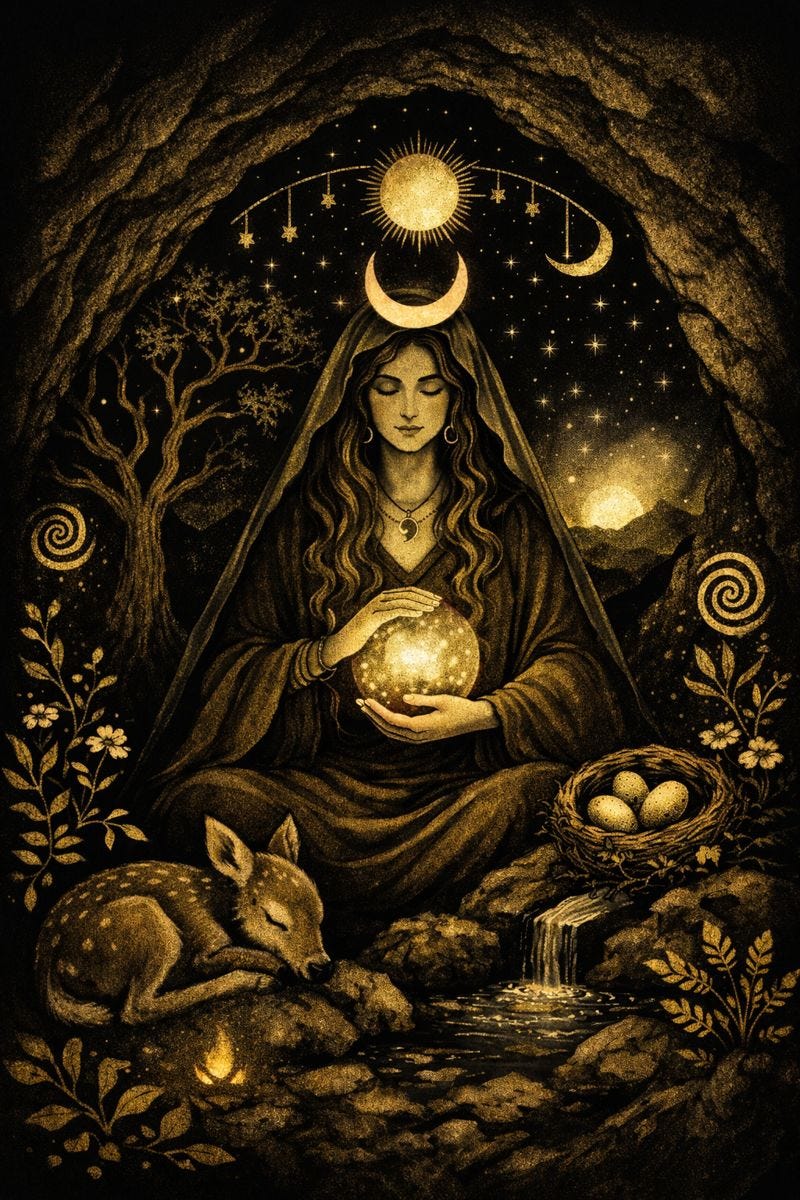
I call in Rhea, ancient Mother of the gods, keeper of wild earth and deep time. She who knew how to hold life while it was still becoming. She who protected what was tender, unfinished, and sacred by hiding it in caves, in mountains, in the body itself. Rhea does not rush emergence. She understands gestation, containment, and the fierce love it takes to let something grow out of sight.
May she remind us that reverence is not waiting—it is active holding.
That love is not passive—it is protection.
And that what is meant to come forth does not need force, only the right ground and the patience of the Mother who knows when the time is right.
If this essay resonates, you’re welcome to become a paid subscriber or buy me a cacao as a small gesture of support. And if you’re standing in a threshold right now, I have a few more open spots for the $111 January Transition Doula sessions.
With reverence,
Sarah
This was one of the most impactful things I've read in a long time. Softness as reverence is a concept I'm going to hold.
This was a soothing read and very timely for me. It got me thinking a bit about the narrative around manifestation. The Internet has warped it into a buzzword with a life of it's own. The hype has swallowed the context. We've come to treat it as a process independent of our bodies and your message is a beautiful reminder of the contrary. Thank you.