
What Was Never Lost
Demystifying Plant Medicine, Part IV

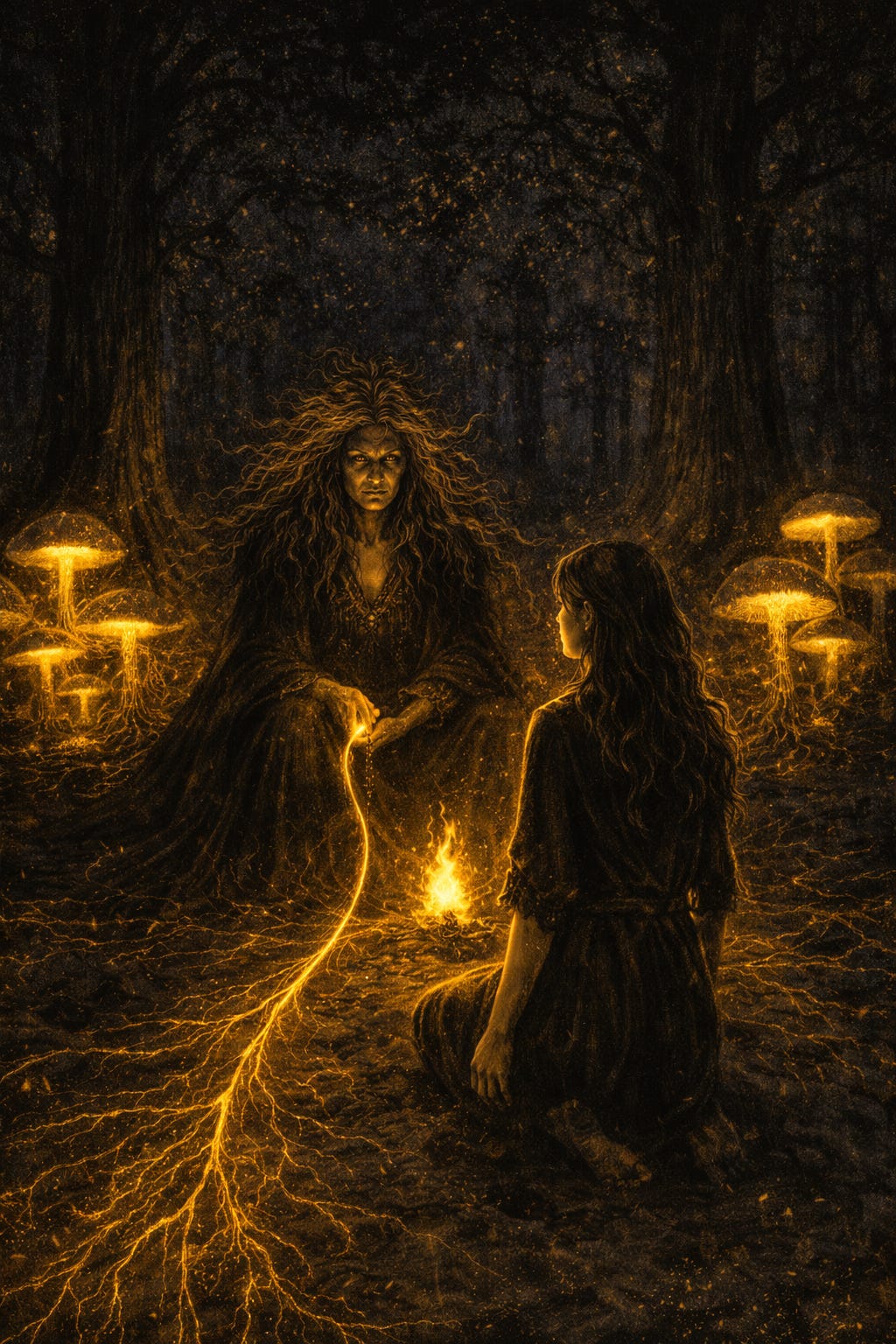
Women have always known about the plants.
In the cellular sense. In the body-memory sense. In the way that when a woman sits with plant medicine for the first time and something in her recognizes it, that recognition is not imagination. It is remembrance.
I have watched this happen. I have felt it happen in my own body. The medicine arrives and something ancient in the feminine system says: oh. Yes. This.
Not surprise. Recognition.
This is the essay I have been building toward across this entire series. Parts I through III were personal — my own journeys, my own losses and commissions, my own practice of holding space for others. This one is wider. This one is about why, in this particular moment in history, so many women are finding their way back to plant medicine. Why the inquiries that come to me are overwhelmingly from women. Why I believe this return is not a trend but a reclamation.
And why Baba Yaga — the wild, fearsome, ungovernable grandmother of the forest — is the goddess who presides over all of it.
What Was Trained Out of Us
Let me start with what was lost. Or rather — what was taken.
For centuries, the women who knew the plants were the most dangerous women in any community. They were the midwives, the herbalists, the healers, the ones who understood what grew in the dark places and what it could do. They knew how to ease labor and how to end it. They knew which roots brought fever down and which brought visions on. They moved between the worlds — the visible and the invisible, the living and the dying — with a fluency that made them essential and, to certain kinds of power, threatening.
So the knowledge was suppressed. The women who carried it were called witches, heretics, madwomen. The connection between women and plant wisdom was severed not gradually but violently, over generations, until what remained was a faint cultural memory — fairy tales about old women in forests, warnings about women who knew too much.
What was also severed, in the same historical movement, was women’s trust in their own bodies.
This is not incidental. It is the same wound.
When you disconnect a woman from the plants that speak to her body’s intelligence, you disconnect her from the intelligence itself. You teach her to distrust what she feels, to seek external authority for what she knows internally, to override the somatic signals that have always been her most reliable source of guidance.
I have written about this in other contexts — the body’s quiet no that arises before the mind has caught up, the contraction that signals misalignment, the cellular knowing that arrives without logic or explanation. This is not mysticism. This is the body’s ancient intelligence, operating exactly as it was designed to. And it is precisely this intelligence that plant medicine, in the right container, restores access to.
Why Women Are Coming Back
The women who come to me are not, by and large, seeking psychedelic experiences. They are not chasing altered states for the pleasure of them. They are seeking something that feels more fundamental.
They want to hear themselves again.
Years — sometimes decades — of performing, adapting, caretaking, shrinking, overriding. Years of being rewarded for producing and punished for feeling. Years of talk therapy that gave them language for their experience without necessarily changing the experience itself. Years of functioning at a high level while something quiet and essential went unheard.
They come to the medicine because somewhere in them, often before they can articulate why, they sense that it will help them hear that quiet thing again.
And it does.
What I have witnessed, over and over, in the journey space with women, is a return to the body. Not a dramatic return — not always visions or revelations or weeping. Sometimes it is quieter than that. A woman becomes aware, for the first time in years, of what her own breath feels like. She notices a tension she has been carrying so long she had stopped registering it as tension. She feels grief she has been managing rather than feeling. She hears a knowing she has been overriding — clearly, unmistakably, in her own body’s language.
The medicine does not give her this knowing. It was always there. What the medicine does is quiet the noise long enough for her to hear it.
This is why I believe plant medicine and the feminine have always belonged together. Not because women are more mystical or more emotional or more suited to altered states — but because the medicine speaks the language the feminine body already knows. It speaks in sensation, in image, in somatic truth. It bypasses the performing mind and goes directly to the knowing body.
And the knowing body, in most women I have worked with, has been waiting a very long time to be heard.
The Womb as Oracle
I want to speak specifically about the womb — because in my own journeys and in the journeys I have held space for, it has consistently been a site of profound intelligence and profound grief.
In my own womb-light journey, a masculine energy placed a light in my womb and what followed was hours of labor — not metaphorical labor but something my body participated in completely, sweating and pacing and releasing in the way the body releases when it is moving something enormous through. What was planted in that journey has been unfolding in me ever since. The podcast. The creative work. The facilitation practice. All of it seeded in that experience, gestated over years, born in its own time.
The womb is not only a reproductive organ. It is a center of creative intelligence, of intuitive knowing, of grief held and life generated. Many women carry in their wombs what they were never given permission to feel — losses unmourned, boundaries uncrossed, desires unspoken. The medicine, in my experience, has a particular relationship with this center. It goes there. It asks what is being held. It offers, if the woman is willing, the space to finally let it move.
I have sat with women in the journey space who have grieved miscarriages they were told to get over quickly. Women who have processed the loss of a creative self that was slowly extinguished by decades of practical demands. Women who have finally felt the full weight of their own desire — not as something shameful or excessive, but as intelligence. As signal. As a compass pointing toward what their life is actually asking of them.
This is not therapy. It is older than therapy.
Sovereignty and the Medicine
There is another theme that runs through the work I do with women, and it is the one I return to most often in my own life and writing: sovereignty.
Sovereignty — as I understand and have written about it — is not about holding yourself together. It is about remaining the authority over your own inner life. It is the refusal to fracture your own identity in order to maintain someone else’s comfort. It is the willingness to disappoint rather than abandon yourself.
Plant medicine, held in the right container, is one of the most direct paths to sovereignty I have encountered.
Because what the medicine does — when it removes the static, when it quiets the noise, when it bypasses the performing mind and goes directly to the knowing body — is show a woman, with a clarity that is sometimes startling, what she actually knows. What she actually wants. What she has actually been feeling beneath the management and the adaptation and the careful performance of okayness.
And once you have heard that — once you have felt your own truth in your own body with that kind of unmistakable clarity — it becomes very difficult to unknow it.
This is why the women who do this work change. Not because the medicine changed them — but because they finally heard themselves. And hearing yourself, truly and completely, is the beginning of sovereignty.
I have watched women leave the journey space knowing, for the first time with full-body certainty, that a relationship needs to end. That a career path is wrong. That a creative impulse they have been suppressing for years is actually a calling. That the grief they have been managing is ready to be fully felt. That the desire they have been dismissing is real and worthy and worth following.
The medicine did not tell them any of this. They already knew. The medicine simply made the noise quiet enough that they could finally hear it.
The Gathering
Something is happening in the world right now that I find myself thinking about often.
Women are gathering. In circles, in living rooms, in forests, in ceremony. In my own community here in the Blue Ridge Mountains, I have watched it happening — a holistic leadership meeting with forty healers in one room, a women’s circle that formed seemingly out of nowhere, strangers who feel like they have always known each other, pulled together by something that doesn’t have a name yet.
Many of these women are finding their way to plant medicine. Not all of them — the gathering is larger than any single practice. But there is something about this moment, this convergence of women who are done performing and ready to feel, that plant medicine is particularly suited to meet.
I think of it as a collective reclamation. Not of something new — but of something that was always ours. The knowledge. The body’s intelligence. The trust in what we feel. The connection to the plants that have always known how to speak to us.
We are not discovering something. We are remembering.
What Baba Yaga Knows
In Slavic folklore, Baba Yaga lives deep in the forest in a hut that stands on chicken legs. She is simultaneously fearsome and wise, monstrous and generous. She does not give her gifts easily. She tests you. She asks you to prove that you are ready — not by being perfect or prepared or unafraid, but by coming with clarity and courage and a willingness to meet what you find.
Women who enter her domain without that readiness do not fare well.
Women who come with it receive everything.
This is the truest description I know of what plant medicine asks of the feminine. It does not reward performance or preparation in the ordinary sense. It rewards honesty. Willingness. The courage to look directly at what you have been carefully not looking at.
Baba Yaga is the wild grandmother who tests you not because she is cruel but because she knows what you are capable of — and she refuses to give you less than what you came for. She is the medicine itself in its most ancient, most feminine, most ungovernable form.
She does not make it easy. She makes it real.
And real, in my experience, is exactly what women are hungry for.
A Note on This Series
When I began writing these essays, I was hesitant. Plant medicine still carries stigma, and I am careful about how I move in public spaces with it. But the questions keep coming, and something in me knew that silence was no longer the right response.
What I have tried to do across these four essays is tell the truth — about my own experiences, about the work I do, about what I believe this medicine offers and to whom and under what conditions. Not to persuade anyone. Not to recruit. But to demystify something that has been shrouded in either taboo or hype, and to offer instead something more useful: an honest account from someone who has sat with it, been changed by it, and built a practice around holding space for others who are ready to do the same.
If any of this has landed for you — if something in your body has been saying yes while you’ve been reading — I’d invite you to trust that signal.
It knows what it’s talking about.
Working with Me
If you are feeling called to work with plant medicine and want experienced, intentional support in preparation, facilitation, or integration, I would love to connect. You can find me and learn more about working together at goddessintraining.online.
Stay in the Field
If this writing landed somewhere real — subscribe to Goddess in Training. New essays and podcast episodes arrive in your inbox as they emerge, honest and in real time.
And if you’d like to support this work in a small, sacred, delicious way — buy me a cacao. It keeps the writing warm and the altar lit.
Thank you for being here.
I love this. And I'm going to restack so others might see it.
For me, the essential oils were the focus. I think I have an Air emphasis and that's a large part of what essential oils bring in through the breath. I also discovered the women's healing through Anwen's story. She was trained by the local wise woman who was also the midwife, and gained the herbal knowledge, she had a plant journey to discover the energy flowing in all things, and she had the deep training in the elements and the guidance from the Goddess. Out these Priestesses would go from their circles of learning...into areas of need which still had their wise women, too. Training and healing circles of nine were in many places, not just Glastonbury or the Priestess Isle. And the Druid Priestesses had to fade back into the populations in the early 6th century. But the wise women remained until the men wanted to become the healers/doctors. I found I had a lineage to a beloved wise woman who was subject to the amazing switch of the new propaganda and was suddenly feared and hanged by the people who had loved her. That's a wound we carry as females. Betrayal and fear of same. It looked as though we were finally able to be ourselves and now, we're not so sure anymore.